Building a Personal AI System with Hermes, Local Models, Automation, and a Shared Knowledge Base
How to move beyond installation and make Hermes the center of a practical personal operating system.
Most Hermes tutorials end when the agent answers its first message. That milestone proves the software works, but it does not prove the system is useful. The larger opportunity is to connect Hermes to the places where personal work already happens: Telegram, email, calendars, health data, social platforms, scheduled jobs, and a searchable knowledge base.
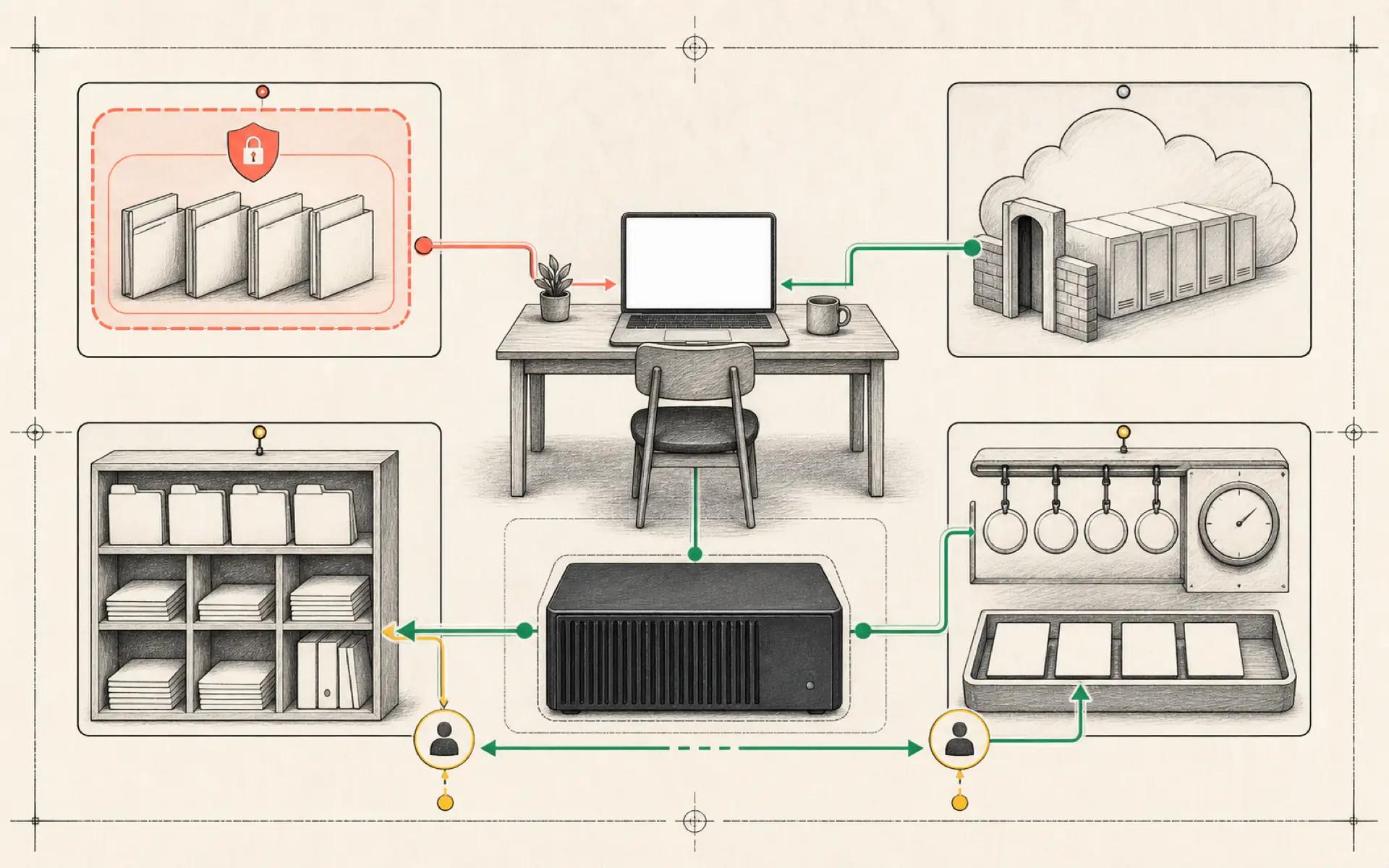
This creates a personal AI system rather than another chat account. Hermes becomes the coordinating layer. Models can change, tools can be added, and specialist agents can participate, while the user’s working knowledge remains in a shared collection of readable files.
Begin with a personal AI wiki
The most durable asset in an agent system is not the model subscription. It is the accumulated record of goals, decisions, procedures, research, and outcomes.
A Markdown-based wiki provides a practical storage format. Markdown files are plain text, easy to back up, searchable with many tools, and compatible with applications such as Obsidian. Hermes can read and update them, and another agent system can use the same collection.
A useful structure might include:
- personal preferences and identity;
- active projects;
- daily logs;
- research notes;
- health and habit summaries;
- content performance;
- reusable workflows;
- decisions and lessons learned.
The wiki should contain curated knowledge rather than every raw conversation. Links to source sessions can be retained when detail matters.
Choose between local and hosted models
Hermes can connect to a hosted model or a local model through software such as Ollama. Local operation provides control and predictable marginal cost, but hardware limitations affect speed and quality.
A hybrid strategy is often strongest. A local model handles private or routine work, while a hosted model handles difficult reasoning. Provider routing can send different tasks to different models. The user can reserve expensive models for the jobs where they produce a measurable improvement.
Fallbacks are important. If the preferred provider is unavailable, Hermes should either use an approved alternative or report the failure. Silent substitution can create unexpected cost or quality changes.
Connect Telegram as the daily interface
Telegram makes it possible to capture ideas and issue instructions from anywhere. A bot can be linked to Hermes and restricted to approved user IDs.
Groups and topics provide further organization. Separate topics can represent research, operations, content, or personal planning. Each topic should map predictably to a Hermes session so context does not bleed between unrelated work.
The desktop dashboard remains important even when Telegram is the primary input. It provides visibility into sessions, cron jobs, files, and failures that are awkward to manage from a phone.
Use cron jobs as the heartbeat of the system
Cron jobs can create a recurring rhythm. A morning job may collect calendar events and high-priority email. An evening job may summarize completed work and update the daily log. A weekly job may review project status or content performance.
A heartbeat job can also look for unresolved items: failed automations, old tasks, or missing data. It should report exceptions rather than generate a long message simply to prove it ran.
Each schedule should specify the model, maximum work, output file, and delivery location. Token usage becomes much easier to control when these decisions are explicit.
Turn personal data into bounded skills
Health data is valuable but sensitive. A Hermes skill can process exported Apple Health information, calculate trends, and write a summary to the personal wiki. The skill should document which files it reads, which metrics it calculates, and what it must not claim.
The output is informational rather than medical advice. Unexpected or concerning trends should be presented for professional review rather than diagnosed by the agent.
The same skill pattern can be applied to social analytics. A Threads analytics skill may collect approved metrics, compare recent posts, and summarize patterns. It should distinguish evidence from speculation and avoid changing the user’s publishing strategy automatically.
Connect email and calendars carefully
Gmail and Google Calendar provide high-value context. Hermes can prepare daily briefings, identify messages needing attention, draft replies, and help plan available time.
Begin with read access. Ask the agent to produce a report and compare it with the source. Sending or modifying data should remain an approval-based action until the workflow is consistently correct.
Calendar automation needs special care with time zones, recurring events, private event details, and invitations. A draft schedule is safer than direct booking during early use.
Hermes and OpenClaw do not have to be rivals
Different agent systems may have different strengths. Hermes can provide memory, scheduled work, and a stable personal interface, while another system handles a specialized tool or workflow.
A shared Markdown wiki allows both systems to contribute without forcing them to share a hidden internal database. Each agent can write to defined folders and include a timestamp, source, and author. Conflicts become visible as file changes rather than mysterious changes in an opaque memory layer.
The agents should not freely edit the same core identity file. Assign ownership and use review for important updates.
Customize roles without creating instruction chaos
Identity files and profiles allow Hermes to adopt specialist roles. A health profile, research profile, and content profile can use different tools and models while sharing selected knowledge.
Profiles should remain narrow. If a profile needs dozens of unrelated tools, it may be a sign that responsibilities should be split. A clear role improves both security and output quality.
The personal wiki can act as the shared truth, while each profile keeps its own procedure files. This balances common memory with operational isolation.
A phased implementation
A personal AI system can be built in six stages:
- Install Hermes and connect one model.
- Create the Markdown wiki and define its folder structure.
- Connect Telegram and organize sessions or topics.
- Add a morning briefing and evening log schedule.
- Introduce one data skill, such as health or content analytics.
- Add email, calendar, local models, or a second agent system only after the core loop is reliable.
At every stage, back up the wiki and configuration. Review what the agent wrote. Remove schedules that do not produce real value.
The durable system is model-independent
Models will improve and providers will change. A personal AI system should survive those changes. Hermes provides coordination, but the durable layer is the user’s organized knowledge and tested procedures.
When data remains in readable files, skills remain inspectable, and permissions remain bounded, the user can change models without rebuilding their entire digital working life. That is the difference between using an AI product and building an AI system.
Hands-on lab: Create a local-model wiki note
Outcome: Hermes uses a local Ollama model to create one reviewable Markdown note inside a personal wiki.
Time: 25–60 minutes, mostly model download time.
Risk: Medium. The recommended tool-capable model needs substantial RAM and disk space; commands run with your user account’s file permissions.
Before you start
Use a machine with at least 24 GB of available RAM and about 20 GB of free disk space for the documented gemma4:31b example. If Ollama is already installed and serving a tool-capable model, reuse it.
ollama --version
curl http://localhost:11434/api/tags
mkdir -p "$HOME/hermes-personal-wiki/inbox"
Build it
Pull the documented tool-capable model, then configure Hermes through the setup wizard. Choose Custom Endpoint, use http://localhost:11434/v1 as the base URL, leave the API key empty or enter no-key, and select gemma4:31b.
ollama pull gemma4:31b
hermes setup

cd "$HOME/hermes-personal-wiki"
hermes
At the Hermes prompt, request one bounded artifact:
Create inbox/first-note.md.
Use the title "My first local Hermes note".
Include: the current date, three reasons I am testing a local model, and a
checkbox named "Reviewed by me". Do not read or modify files outside this
directory. When finished, report the exact file path.
Verify it
Exit the chat after Hermes reports completion, then inspect the artifact and the active Ollama process.
test -s "$HOME/hermes-personal-wiki/inbox/first-note.md"
sed -n '1,40p' "$HOME/hermes-personal-wiki/inbox/first-note.md"
ollama ps
Success means the note exists, contains all requested fields, and can be reviewed in any Markdown editor.
If it fails
- If Hermes cannot reach Ollama, verify curl http://localhost:11434/api/tags and restart Ollama before rerunning setup.
- If the model chats but cannot create the file, confirm that the selected model supports tool calling; the smaller models listed in the Ollama guide are chat-only.
- If responses time out on CPU, add HERMES_API_TIMEOUT=1800 to ~/.hermes/.env and start a new Hermes session.
- If context-length checks fail, follow the official guide’s 64K-context Modelfile instructions.
Safety, privacy, and cost
Local inference avoids per-token API charges and keeps prompts on the machine, but web search, cloud tools, or configured fallback providers can still send data externally and incur charges. Do not place sensitive material in the wiki until file permissions and backups are defined. Review every generated note before moving it from inbox into durable memory.
Official references
Source video: Master Hermes Agent in 41 mins, Keith AI. Adapted and reorganized from the full transcript; promotions and repeated installation narration were removed.