Ten Underused Hermes Features That Reveal Its Real Power
Persistent identity, session recovery, reusable skills, gateways, schedules, subagents, profiles, model switching, side questions, and event hooks.
Many people use Hermes as a slightly more capable ChatGPT: they connect Telegram, ask questions, and stop there. This misses the architecture that makes Hermes useful as agent infrastructure.
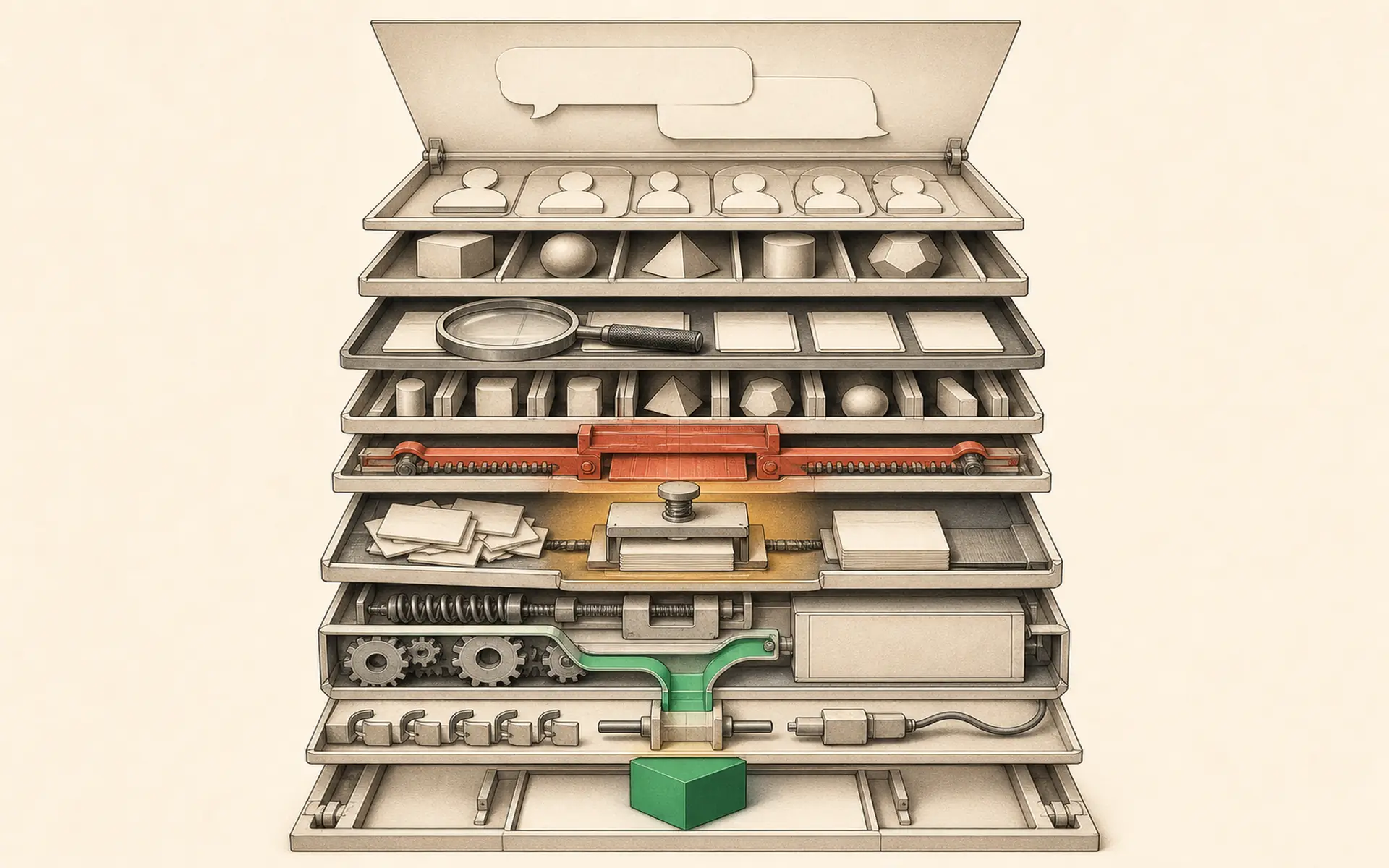
Its deeper features solve recurring operational problems. They preserve identity, recover earlier decisions, separate roles, schedule work, delegate tasks, and react to events. Together, they form an operating layer for ongoing work rather than a single conversation.
1. SOUL.md: persistent identity and boundaries
The case-sensitive SOUL.md file describes how the agent should behave. It can define voice, priorities, values, communication style, and approval rules.
The file should be specific but short. Statements such as “be helpful” add little. More useful guidance includes how to present uncertainty, when to ask permission, which language to use, and how to handle conflicting instructions.
Because the file is readable, identity changes can be reviewed and versioned. This is safer than allowing personality to drift invisibly through chat history.
2. Session search: recover earlier decisions
Long-running work produces decisions that are difficult to find manually. Session search allows the user to locate previous discussions, links, and conclusions.
Search is especially useful before repeating research or changing a plan. Ask for the earlier decision and the surrounding rationale, not merely a keyword match. Important findings should then be promoted into project notes or durable memory.
Session search is a recovery tool, not a replacement for organized documentation.
3. Skills: turn prompts into workflows
A skill captures a repeatable procedure. Instead of re-explaining how to prepare a report or process a lead, the user invokes the skill.
A good skill states its purpose, required inputs, steps, tools, output format, checks, and limits. It should be tested on several examples and revised when a real edge case appears.
Skills are one of the clearest ways Hermes becomes more useful over time. Improvement is stored in a visible artifact rather than left inside one forgotten conversation.
4. Telegram gateway: a genuine control surface
Telegram is more than a place to receive answers. Commands, topics, files, and notifications can make it a remote control surface for Hermes.
Different topics can map to separate projects. Scheduled reports can arrive in dedicated channels. Approval requests can be handled from a phone.
The gateway must restrict allowed users and protect the bot token. Final artifacts should be stored in the project system even if Telegram is the place where they are reviewed.
5. Cron jobs: recurring agent work
Cron jobs allow Hermes to operate on a schedule. Useful examples include morning briefings, weekly research, health checks, and project reviews.
The schedule should state time zone, model, data sources, output destination, and behavior when nothing changed. Trigger the job manually before trusting the schedule.
Recurring work should be reviewed periodically. A report that nobody reads should be paused, even if it runs successfully.
6. Subagents: parallel research and execution
Subagents can work on independent parts of a larger task. The main agent coordinates them and integrates their outputs.
Delegation works best when each subtask is narrow and the response format is defined. The main agent should not simply concatenate answers; it must resolve duplication and disagreement.
Subagents also need permission boundaries. A research agent rarely needs credentials that allow publishing or account changes.
7. Profiles: separate agent workspaces
Profiles allow one Hermes installation to support several roles. Each profile can use its own model, tools, memory, and identity files.
A client profile can remain separate from a personal profile. A coding profile can use a model optimized for software, while a research profile uses a model selected for long-context synthesis.
Profiles reduce context pollution, but they are not always equivalent to strong user isolation. Sensitive clients may require separate instances and credentials.
8. Model and provider switching
Different tasks justify different models. Hermes can switch providers or models without rebuilding the whole agent.
Use cheaper models for routine classification and premium models for difficult reasoning. Maintain an approved fallback and record which workflows have been tested with each model.
Changing the model can change tool-use behavior and writing style. Test the workflow after switching rather than assuming compatibility.
9. /background and /btw: independent background sessions
/background <prompt> — also available as /bg or /btw — starts a separate agent session while the current session stays available. The background agent receives only the prompt you give it; it does not inherit the foreground conversation history, though it uses the same model, provider, toolsets, and related runtime settings.
Use it for a self-contained research or file-analysis task, then review the returned result before applying it to the foreground plan. Put every required path, constraint, output format, and safety boundary in the background prompt because missing foreground context is not filled in automatically.
10. Hooks and BOOT.md: react to events and startup
Hooks run when defined events occur. A hook may respond to a new file, webhook, task-state change, or other signal. Hermes does not ship a built-in BOOT.md hook; the documented pattern is to create a ~/.hermes/BOOT.md checklist and a user-defined gateway:startup hook that reads it and runs a one-shot agent.
Startup actions should be lightweight and safe. Suitable examples include verifying required directories, loading a short status note, and reporting disabled integrations. Avoid heavy or destructive work that runs every time the service restarts.
Event hooks should validate their source and be designed to tolerate duplicate delivery. An external service may send the same webhook more than once.
Hermes as infrastructure
These features reveal the platform’s real shape. Identity provides behavioral continuity. Session search and memory preserve knowledge. Skills preserve procedures. Gateways provide access. Cron jobs and hooks provide initiative. Subagents and profiles provide delegation and isolation. Model switching provides flexibility.
The result is not simply a smarter conversation. It is a configurable infrastructure layer for agents, memory, workflows, messaging, and tools.
Begin with the feature that solves the most immediate problem. If old decisions are lost, use session search and project notes. If prompts repeat, create a skill. If work must happen regularly, add a cron job. If instructions conflict, split profiles. Purpose-driven adoption keeps the system useful instead of merely complicated.
Hands-on lab: Run real background work with /background and /btw
Outcome: A research task runs in an isolated background session while the foreground conversation remains usable.
Time: 5–10 minutes.
Risk: Medium. Each background task is a separate model-backed session with inherited tools and permissions.
Before you start
Start a normal Hermes CLI session in a directory containing a harmless README or other non-sensitive text. Background sessions receive only the prompt you give them; they do not inherit the foreground conversation history.
cd /path/to/a/non-sensitive/project
hermes
Build it
At the Hermes prompt, start one explicit background task. Continue using the foreground immediately, then inspect active work.
/background Read README.md and return five questions a new contributor would ask. Do not modify files.
/status
/tasks
The alias /btw has the same semantics. It is not a lightweight side question added to the current conversation; it starts another independent background session.
/btw Read README.md and list any setup steps that lack a verification command. Do not modify files.
/tasks
Verify it
Success has three visible signals:
- Hermes immediately assigns each background task an ID and returns control to the foreground prompt.
- /tasks shows the task while it is running.
- The result later appears in a separate background result panel rather than as context injected into the foreground conversation.
If it fails
- Use /help or the slash-command autocomplete to confirm that /background is available in the installed version.
- If the task lacks context, rerun it with the exact file path and expected output; the background session cannot infer facts from your foreground chat.
- Use /tasks to inspect active tasks. Stop or cancel work that is stuck instead of starting duplicates.
Safety, privacy, and cost
Background agents inherit the current model, provider, toolsets, and file permissions. A separate session is context isolation, not a filesystem sandbox. Avoid broad prompts over private directories, and never place credentials in the prompt. Starting tasks in parallel can multiply token and tool costs, so use a bounded output contract and only the number of workers the task needs.
Official references
Source video: 10 Hermes Agent Features Most People Aren’t Using, Sharbel A. Adapted and reorganized from the full transcript; calls to subscribe and other promotional passages were removed.