Seven Cost-Aware Hermes Workflows That Go Beyond Chat
How desktop profiles, wake conditions, no-model jobs, organizational memory, event-driven actions, and reusable skills create practical automation.
An AI agent becomes expensive and noisy when it calls a language model for every scheduled check, even when nothing has changed. Hermes includes several patterns that allow ordinary code to perform the cheap part of a workflow and reserve model reasoning for the moments that actually need it.
This distinction is central to useful automation. The agent should not think merely because a timer fired. It should think because a meaningful event requires interpretation, communication, or action.
1. Use desktop profiles as separate operating environments
Hermes Desktop provides a visual wrapper around configuration and agent activity. Its most useful organizational feature is the ability to run separate profiles.
Each profile can have its own memory, skills, model preference, and purpose. A finance-monitoring profile does not need the same instructions or tools as a social-media profile. Separating them reduces instruction conflicts and makes cost attribution easier.
Profiles are also safer than putting every permission into a single general assistant. The financial profile can receive read-only billing access, while the content profile receives access only to approved drafts and publishing tools.
2. Wake the agent only when a threshold is crossed
A wake condition allows a scheduled job to decide whether the language model should be called. A lightweight script checks the current state first. If nothing important has changed, the job ends without spending model tokens.
This pattern is ideal for cloud-cost monitoring. A script can retrieve AWS or Gemini API spending and compare it with a baseline. Normal daily movement requires no analysis. A sudden increase wakes Hermes, which can examine the services involved, prepare a plain-language explanation, and notify the correct channel.
The same pattern applies to revenue, error rates, inventory, or customer reviews. The trigger must be explicit: a percentage change, absolute threshold, new severity level, or unusual pattern. A vague instruction such as “tell me if anything looks strange” forces the model to run every time.
3. Use no-model jobs for deterministic health checks
Some work does not require a language model at all. A no-agent or no-model job can execute a script inside the Hermes environment and deliver its output directly.
A TLS certificate check is a good example. Code can calculate the number of days until expiry with complete precision. A model adds little value unless the certificate is close to expiry or the check fails. The normal result can be a short status line; an abnormal result can tag Hermes for diagnosis.
Other candidates include:
- HTTP health checks;
- backup completion checks;
- Stripe application status;
- disk-space thresholds;
- known-format data exports;
- simple count or checksum comparisons.
These jobs are faster, cheaper, and easier to verify than model-driven equivalents.
4. Build an organizational second brain in Slack
Hermes can participate in a team channel and gradually accumulate useful working knowledge. The goal is not to archive every message. It is to convert recurring questions, decisions, and procedures into curated memory and reusable skills.
For example, after helping with several launch checklists, Hermes can propose a company launch skill. After repeated discussions about how customer feedback is categorized, it can record the agreed taxonomy. New team members can then query the same system instead of reconstructing procedures from old threads.
This second brain needs ownership. Someone should review new memories and skills, remove obsolete guidance, and decide which channels are allowed to contribute. Private or sensitive conversations should not flow into shared memory by default.
5. Let events trigger bounded actions
An agent does not need to wait for a schedule. Webhooks can notify Hermes when something happens: a new lead arrives, a payment fails, an app review is posted, or a form is submitted.
A Gmail lead-response workflow may use built-in Google Workspace skills to read a new enquiry, collect relevant context, and draft a response. During early deployment, the draft should wait for approval. Once the qualification rules are proven, low-risk replies may be automated while unusual cases remain in the review queue.
Event-driven design is more efficient than asking the agent to scan an entire inbox every few minutes. It also provides clearer causality: each run is linked to a specific event.
6. Turn strategic documents into active skills
A product requirements document, or PRD, often becomes stale after it is written. Hermes can treat the document as an operational skill that guides recurring competitor research.
A weekly job can inspect competitor releases, pricing, positioning, and customer feedback. Hermes compares new evidence with the PRD, identifies threats or opportunities, and proposes updates. The result is not simply a news summary; it is analysis anchored to the organization’s current product goals.
The PRD should not be rewritten automatically without review. A safer workflow produces a proposed change set with sources and a short explanation of the impact.
7. Repurpose approved content without surrendering publishing control
Hermes can transform a finished YouTube script into drafts for X, LinkedIn, newsletters, and other channels. A reusable content skill can define voice, length, formatting, prohibited claims, and the review process.
The agent should work from an approved source rather than inventing a new position for every platform. It can create variants and place them in a review queue. Automatic posting should be introduced only after the drafts are consistently safe and on brand.
This workflow demonstrates the broader pattern: Hermes performs repeated transformation, while the human retains final editorial authority.
Design automations as filters, not constant thinkers
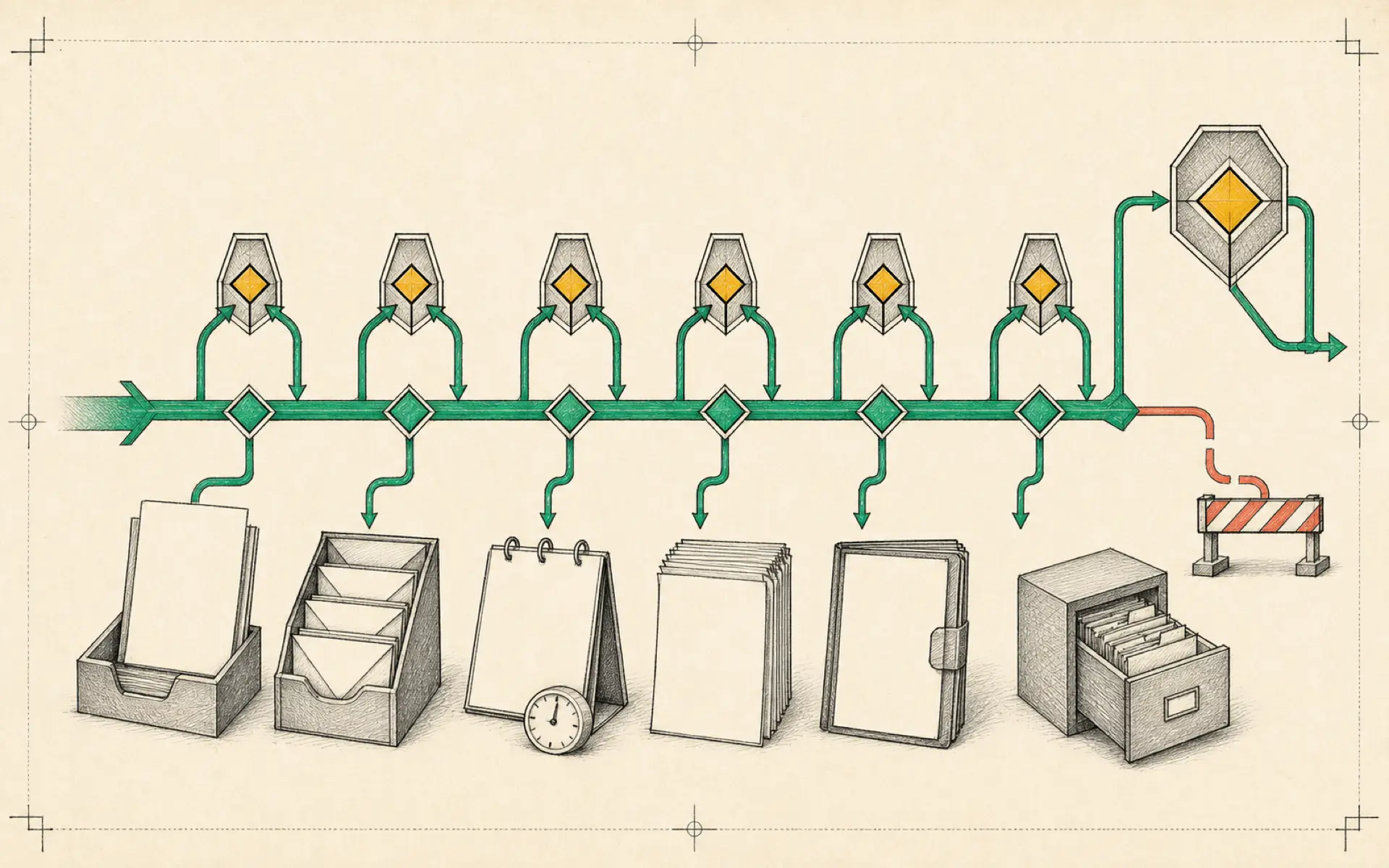
The most efficient Hermes system uses layers:
- Deterministic code collects and checks data.
- A wake condition decides whether anything matters.
- Hermes interprets the meaningful event.
- A policy decides whether the agent may act or only recommend.
- The result is delivered to a known channel and recorded.
This design lowers cost and reduces alert fatigue. It also makes failure easier to diagnose because collection, decision, reasoning, and action are separate steps.
Hermes is most powerful when it is not invoked unnecessarily. The objective is not to maximize agent activity; it is to create a system that notices the right events, uses intelligence selectively, and produces an accountable response.
Hands-on lab: Build a zero-token change alert
Outcome: A script-only cron job stays silent during normal checks and writes an alert only when a test condition changes.
Time: 15 minutes.
Risk: Low. The lab uses local files and local delivery; it does not call an LLM on scheduled ticks.
Before you start
Confirm that Hermes is installed and that the scheduler is healthy. This lab uses Bash and the default Hermes home at ~/.hermes.
hermes doctor
hermes cron status
mkdir -p ~/.hermes/scripts
Build it
Create a deterministic checker. The presence of a flag file represents a changed cost threshold, so you can test both the quiet and alert paths without connecting a billing account.
cat > ~/.hermes/scripts/cost-watch.sh <<'EOF'
#!/usr/bin/env bash
set -euo pipefail

FLAG="$HOME/.hermes/scripts/cost-alert.flag"
if [[ -f "$FLAG" ]]; then
  echo "Cost alert: the test threshold changed. Review the billing source."
fi
EOF

chmod +x ~/.hermes/scripts/cost-watch.sh
rm -f ~/.hermes/scripts/cost-alert.flag

hermes cron create "every 1h" \
  --no-agent \
  --script cost-watch.sh \
  --deliver local \
  --name "cost-watch"
Verify it
First confirm that the script emits nothing. Then create the flag and confirm that it emits one alert. Finally trigger the scheduled job manually and inspect its registration.
bash ~/.hermes/scripts/cost-watch.sh
touch ~/.hermes/scripts/cost-alert.flag
bash ~/.hermes/scripts/cost-watch.sh

hermes cron list
hermes cron run cost-watch
hermes cron status

rm -f ~/.hermes/scripts/cost-alert.flag
Success means the direct script test prints exactly one alert only while the flag exists, the job appears in the cron list, and the scheduler accepts the manual run.
If it fails
- If creation rejects the script, confirm that it lives directly under ~/.hermes/scripts; Hermes blocks paths outside that directory.
- If the job never runs, use hermes cron status and fix the scheduler before changing the script.
- If the quiet test prints text, run the script directly with bash and remove the flag file before testing again.
Safety, privacy, and cost
Keep API keys out of the script and cron definition. Replace the flag with a read-only billing or metrics check only after the local behavior is correct. Script-only mode skips the agent loop and LLM spend, but any third-party API queried by your final script may still charge for requests. Use local delivery until the alert text is safe to send to a shared channel.
Official references
Source video: 6 Insane Hermes Agent Use Cases That You Need Right Now, AI LABS. Adapted and reorganized from the full transcript and video notes; sponsorship was removed.