Tool Registry
What it is
The central registry for tool schemas, handlers, availability checks, and toolset membership.
In plain terms
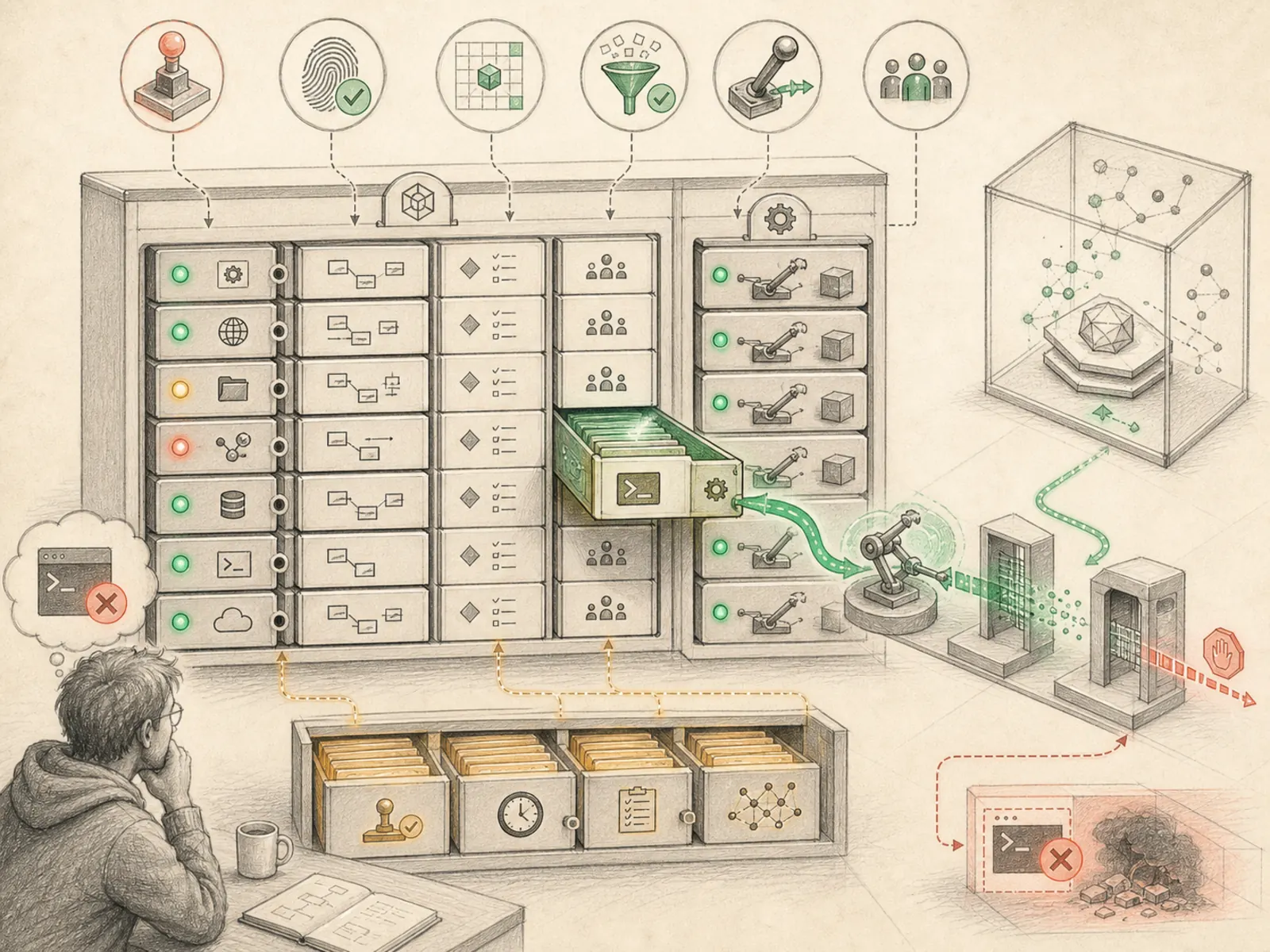
Picture a hospital’s on-call board: every specialist’s name is posted with what they treat, how to page them, and whether they’re actually on shift right now. The registry is that on-call board for Hermes — one place holding every tool’s instructions, the code that runs it, and a rule for whether it’s currently usable, instead of those details being scattered across the codebase.
Why it matters
Tool declarations are distributed across tool modules, which call registry.register() when imported; tools/registry.py provides the central ToolRegistry implementation that stores those entries and filters their availability. Turn context consults the resulting registry when deciding which tools the model can see, so a declaration can exist in its own module yet remain unavailable when its check_fn fails.
How it works
Each tool file calls registry.register() at import time — once per tool it defines — handing over its name, schema, handler, toolset label, and an optional check_fn that probes whether the tool can actually run right now (tools/registry.py). Check results are cached for about 30 seconds so a repeat probe doesn’t hit Docker or the filesystem on every turn, but the real flake protection is a separate 60-second grace window: when a probe fails soon after it last succeeded — say Docker timing out once — the last known “available” verdict is served instead of the fresh failure, so one blip doesn’t strip a whole toolset from an agent mid-turn. Only a failure that persists past that window gets cached and honored. When the agent needs its tool list, get_definitions() walks the requested names, skips anything whose check just failed, and returns OpenAI-format schemas, applying any last-minute description overrides (such as delegation limits) before sending them out.
A concrete example
A developer wonders why their coding agent suddenly can’t run shell commands.
- They check
hermes toolsand see terminal listed as enabled. - Behind the scenes, the registry’s check for terminal requirements had failed once (a busy Docker daemon) and, outside the grace window, the failure stuck for 30 seconds.
- The next turn, the probe succeeds again and the terminal tool reappears in the model’s available list without anyone touching config.
How it connects
This note belongs to the Tools family. Its closest neighboring concepts are: Video Generation, Toolsets, Agent Runtime, Personal OS.
Source evidence
vendor/hermes-agent/tools/registry.py:427-438#tools.registry.ToolRegistry.register— Verified Source Map evidence for ToolRegistry. The registry freezes registration inputs intoToolEntry, retaining the handler andcheck_fn; it exposes only entries whose cached availability probe passes, dispatches synchronous or asynchronous handlers, and normalizes their results.
Workflows
- No first-pass workflow mapping yet; this concept still appears in the vault graph through articles and source evidence.
Related articles
- No article currently mentions this concept by name/alias often enough to qualify (see mention-mining policy).