Slack Second Brain
What it is
A team knowledge workflow that turns channels and decisions into a searchable shared memory.
In plain terms
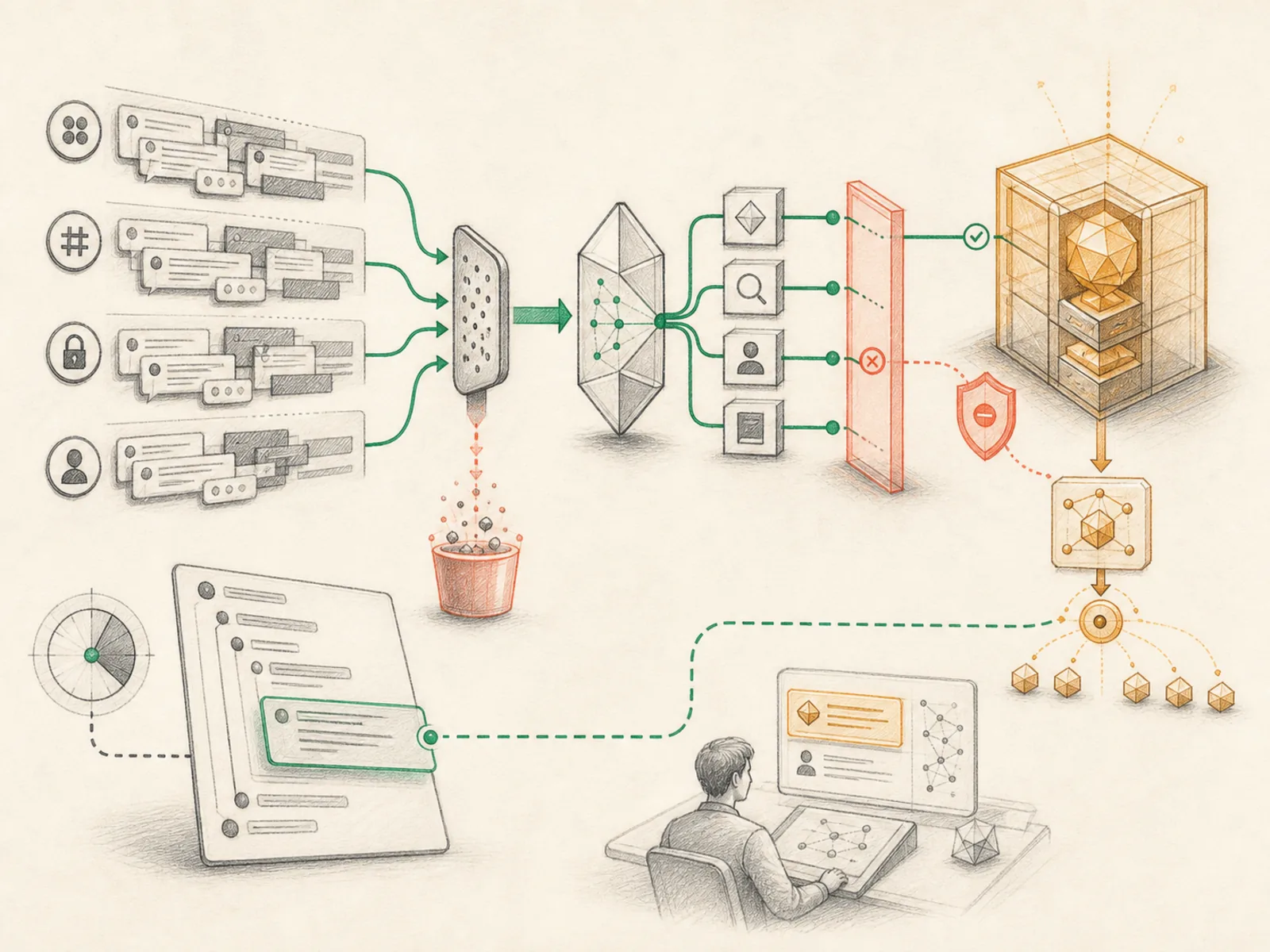
Imagine an office where every Slack exchange automatically gets photocopied into a shared filing cabinet, indexed by what people actually said rather than only by date, so six months later someone can ask ‘why did we choose vendor X?’ and pull up the exact exchange instead of scrolling through months of channel history. Slack Second Brain is that cabinet — the record outlives whoever typed the original message.
Why it matters
Hermes doesn’t run a separate knowledge base for Slack: GatewayRunner (gateway/run.py) feeds every platform’s messages, Slack included, into one SQLite session store built for the session_search tool, and adapter.py’s _fetch_thread_context() pulls prior conversations.replies history back in the first time the bot is mentioned mid-thread. session_search’s discovery mode returns a match’s session plus its opening and closing messages, letting someone ask why a decision was made instead of scrolling channel history by hand. sessions.retention_days (cli.py) can prune that same store on a schedule, though the setting isn’t Slack-specific.
How it works
Behind the scenes, SlackAdapter connects to the workspace using slack-bolt in Socket Mode, authenticated with a SLACK_APP_TOKEN (plugins/platforms/slack/adapter.py). By default, every Slack thread — and, since each top-level DM reply also spawns its own thread, every direct-message exchange too — becomes its own isolated Hermes session rather than one continuous blob, so unrelated conversations don’t get tangled together in the record. session_search (tools/session_search_tool.py) is what turns that pile of sessions into a second brain: its discovery mode runs an FTS5 full-text query across the SQLite session store and returns matching exchanges, its scroll mode jumps to one exact spot in a known session, and a profile argument lets it reach read-only into a different Hermes profile’s own session history.
A concrete example
A team debated pricing tiers in a Slack thread three weeks ago, reached a decision, and moved on — nobody wrote it down anywhere else.
- A teammate who wasn’t in that conversation asks Hermes, in a completely different channel, ‘what did we decide about the pricing tiers?’
- Hermes calls session_search with that phrase; discovery mode finds the old thread’s session by matching its actual wording, not a manually tagged keyword.
- It returns the relevant messages from that exchange, including the reasoning that led to the final call.
- The teammate gets a direct answer instead of being told to go scroll back through weeks of channel history themselves.
How it connects
This note belongs to the Workflow Patterns family. Its closest neighboring concepts are: Content Repurposing, Kanban Execution, Agent Runtime.
Source evidence
plugin:platforms/slack— Explicit Source Map scope boundary: The platform plugin is outside the approved Core scope.vendor/hermes-agent/toolsets.py#<file>— Structural Source Map fallback for toolsets.py. A core source file in the Tool Registry and Toolsets structure within Tools, Toolsets, and MCP.
Workflows
- Slack Second Brain
Related articles
- Seven Cost-Aware Hermes Workflows That Go Beyond Chat