Knowledge Curation
What it is
The discipline of selecting what should become memory and what should remain transient.
In plain terms
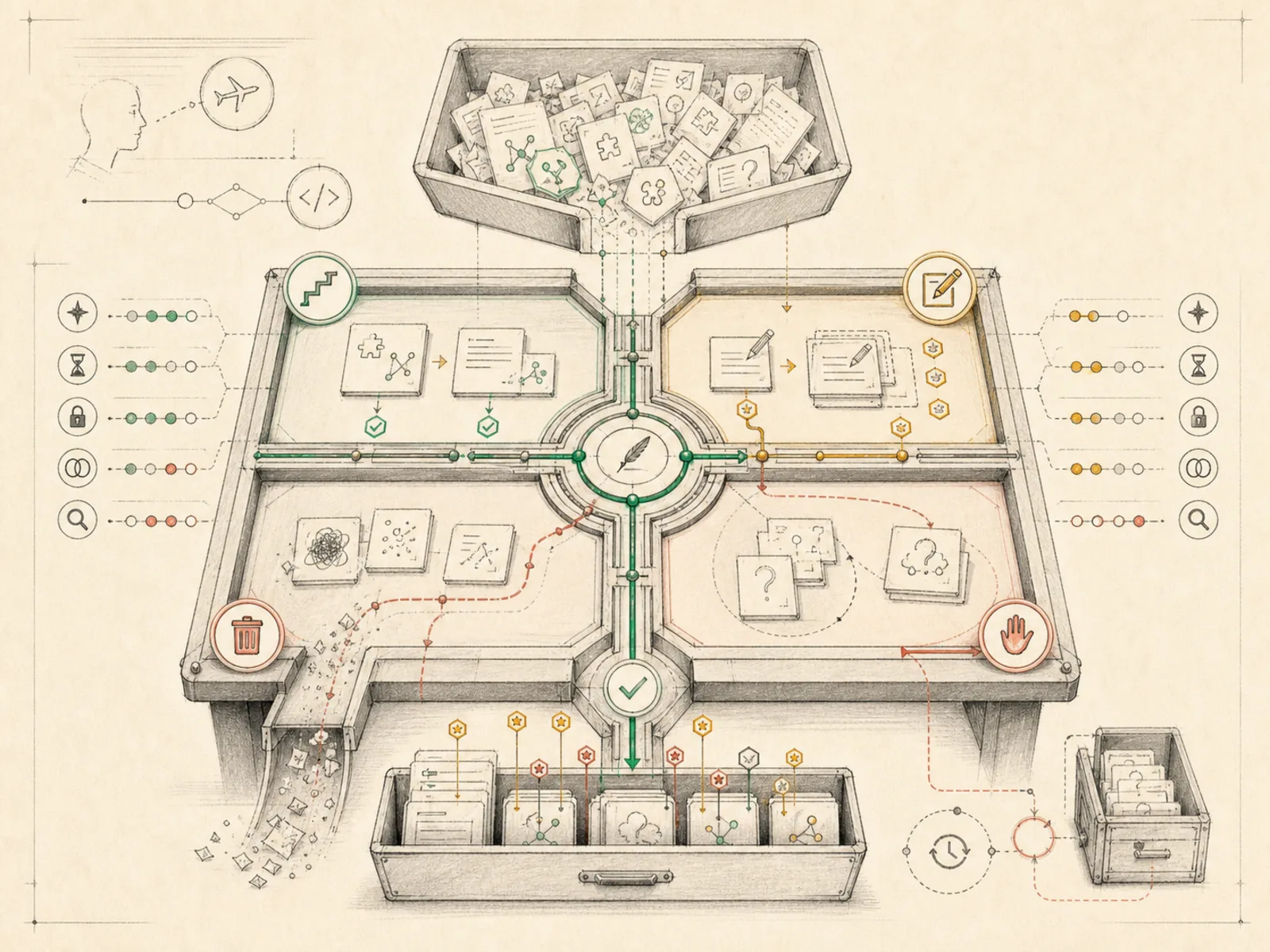
Picture a shoebox of old photos on its way into a scrapbook: a picture with real memories earns a spot glued in, while a forgettable snapshot stays in the box. Knowledge curation is Hermes weighing each fact the same way before it earns a permanent spot in memory, prioritizing a stated preference or correction over a fact that is easy to look up again or only mattered for a single afternoon.
Why it matters
Deciding what deserves to become memory and what should stay transient is harder than it sounds — get it too permissive and memory fills with noise that crowds out what actually matters; get it too conservative and the agent keeps forgetting things a user expected it to retain. Knowledge curation is the discipline that draws that boundary on purpose, not by accident. Research briefing loops and the Slack second brain workflow both lean on curation specifically to avoid becoming an unfiltered archive.
How it works
The memory tool’s own schema (tools/memory_tool.py) spells out the judgment call: save proactively when the user states a preference, correction, or personal detail, or when a stable environment fact emerges, ranked user preferences and corrections above environment facts above procedures. It explicitly lists what to skip - trivial or easily re-discovered facts, raw data dumps, task progress, and temporary state, which belongs in session search instead. That judgment is enforced structurally, not just by instruction: MEMORY.md and USER.md are capped at roughly 2,200 and 1,375 characters respectively, so once memory fills up, a fresh add is rejected until something stale is replaced or removed - ideally bundled into one atomic batch call rather than spread across a whole turn. The llm-wiki skill applies a parallel rule for wiki pages: create one only once a topic recurs across two or more sources, or is central enough to a single one.
A concrete example
A user mentions, in passing, that their flight got delayed, then adds that they always want commit messages under 50 characters. Hermes saves the commit-message habit to USER.md as a durable preference but skips the flight delay entirely - it is true, but gone by tomorrow and worth nothing to remember. When memory later fills to its character limit, a new fact about the user’s preferred editor gets added only after Hermes replaces an older, now-redundant entry in the same tool call.
How it connects
This note belongs to the Memory family. Its closest neighboring concepts are: Personal Wiki, Retention, Agent Runtime, Personal OS.
Source evidence
vendor/hermes-agent/tools/memory_tool.py:1022-1032#memory_tool— Verified Source Map evidence for memory_tool. The memory tool routes a single operation by action toadd,replace, orremove; this flow continues through theaddbranch.
Workflows
- Research Briefing Loop
- Slack Second Brain
Related articles
- No article currently mentions this concept by name/alias often enough to qualify (see mention-mining policy).