Standard Operating Procedures
What it is
Repeatable procedures encoded as skills or workflow notes.
In plain terms
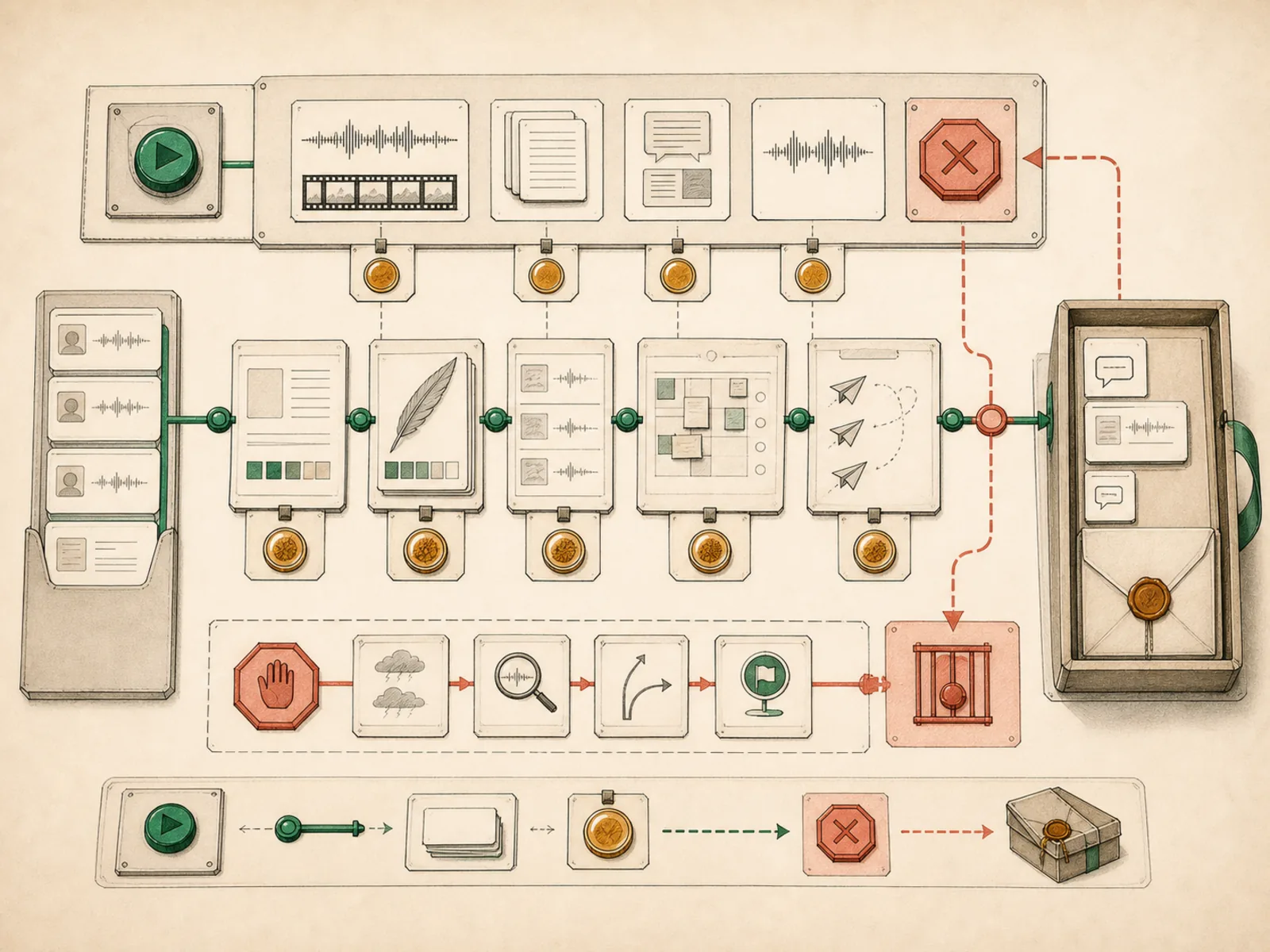
Think of a recipe written out for a substitute chef: the ingredients, steps, and finishing touches are spelled out clearly enough that someone who has never made this dish before can follow it through to a finished plate, without a phone call back to the original cook. Standard operating procedures are Hermes’s version of that written recipe — a task’s steps spelled out clearly enough that a different agent entirely, not just the one that started the work, can carry it through.
Why it matters
Handing a task off between subagents in an agent team delegation only works if the procedure is explicit enough for a different agent instance to pick it up mid-task — standard operating procedures are what encode that explicitness instead of relying on tacit knowledge a single continuous session might get away with. They sit between a one-off skill and a full workflow, repeatable enough to be reused but not tied to just one automation. An SOP that breaks down identically on repeat runs is usually the clearest signal that a self-improving-skills pass is overdue.
How it works
A SKILL.md file is written with explicit sections — when to use it, the numbered procedure, known pitfalls, and how to verify it worked — rather than as a loose note only the original agent instance would understand (website/docs/user-guide/features/skills.md). That explicitness matters most at a real handoff boundary: when one agent spawns another through delegate_task, the child starts as a brand-new AIAgent with no shared conversation history, no memory, and no context files — its entire task definition is whatever goal and context strings got passed in (tools/delegate_tool.py). A procedure written as a real skill survives that boundary intact; a habit kept only in one session’s head does not. Skills also get patched in place once a real run exposes an ambiguous step, rather than staying an untested first draft.
A concrete example
A content team builds a repurposing SOP: pull three social posts and one newsletter blurb from a long video transcript, follow a fixed voice guide, and route drafts to Slack for approval before anything posts. Because it’s written as a skill rather than a habit, it survives being handed off through delegate_task to a fresh subagent that has never seen the earlier conversation — the child reads the goal, follows the procedure, and returns drafts. When a post ships with the wrong tone twice in a row, the team patches the SOP’s voice section once instead of re-explaining it in every future request.
How it connects
This note belongs to the Skills family. Its closest neighboring concepts are: Self-Improving Skills, soul.md, Agent Runtime, Personal OS.
Source evidence
vendor/hermes-agent/agent/skill_utils.py#<file>— Structural Source Map fallback for agent/skill_utils.py. A core source file in the Skill Discovery and Invocation structure within Skills and Plugins.
Workflows
- Agent Team Delegation
Related articles
- Ten Hermes Workflows That Turn a Chatbot into a 24/7 Assistant